Hip Arthroscopy Rehab Protocol
This rehabilitation protocol is designed for patients undergoing hip arthroscopy for conditions including femoroacetabular impingement (FAI), labral repair or reconstruction, chondral procedures, loose body removal, capsular repair, and related hip preservation procedures.
The goal of rehabilitation is to safely restore hip mobility, dynamic stability, neuromuscular control, strength, and functional movement while protecting healing tissues. Recovery after hip arthroscopy requires a gradual, criterion-based progression. Although many patients begin feeling improved early in recovery, biological healing of the labrum, capsule, cartilage, and surrounding soft tissues continues for several months.
This protocol is intentionally conservative and designed to minimize postoperative irritation, muscular compensation, persistent inflammation, and overload of healing structures.
Progression should always be individualized based on:
- Surgical findings and procedures performed
- Tissue quality
- Pain and inflammation response
- Range of motion restoration
- Movement quality
- Strength progression
- Functional recovery goals
Communication between the patient, physical therapist, athletic trainer, and Dr. Ford is strongly encouraged throughout recovery.
Surgical Conditions Commonly Treated with Hip Arthroscopy
Femoroacetabular Impingement (FAI)
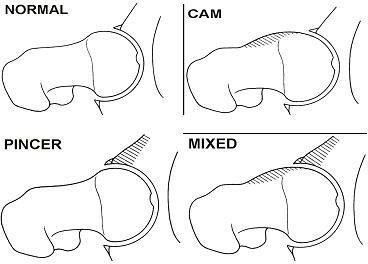
FAI occurs when abnormal bone morphology leads to mechanical conflict between the femoral head-neck junction and the acetabular rim. This can happen due to genetics or can be related to certain sports at a young age, such as horseback riding, gymnastics, and hockey.
Cam Impingement
A bony prominence forms along the femoral head-neck junction, decreasing clearance during hip motion and increasing stress on the labrum and cartilage. This can lead to pain with bringing your hip and knee up towards your chest or with rotating the hip inward. Over time, this “impingement” can cause tearing to the labrum.
Pincer Impingement
A pincer lesion is when there is “extra bone” on the hip cup side. Excess acetabular coverage causes abnormal contact against the femur, often resulting in labral injury and cartilage overload. It can lead to loss of hip motion and pain with certain hip rotations.
Many patients present with a combination of both cam and pincer morphology.
Labral Tears
The acetabular labrum is a fibrocartilaginous structure that deepens the hip socket, contributes to joint stability, and helps maintain the hip suction seal. Injury to the labrum may produce groin pain, clicking, catching, stiffness, or instability. The pain will be felt in the groin and your symptoms may become more noticeable with flexing your hip up towards your chest.
Chondral Injury
Focal cartilage damage may occur alongside impingement or labral pathology. Arthroscopy may involve chondroplasty, microfracture, or cartilage restoration techniques depending on lesion characteristics.
Loose Bodies
Loose fragments of cartilage or bone may become trapped within the joint and cause locking, pain, or mechanical symptoms.
Internal Snapping Hip Syndrome
Tightness or irritation involving the iliopsoas tendon (hip flexor) can contribute to painful snapping sensations within the anterior hip.

Postoperative Considerations
Normal Early Symptoms
The following symptoms are common during early recovery:
- Hip tightness or stiffness
- Mild groin discomfort
- Fatigue with prolonged standing or walking
- Gluteal weakness
- Hip flexor irritation
- Mild swelling or bruising
- Temporary gait abnormalities
Contact Dr. Ford If You Experience:
- Fever greater than 101°F
- Significant calf pain or swelling
- Increasing redness or drainage from incisions
- Shortness of breath
- Progressive numbness or weakness
- Severe uncontrolled pain
General Rehabilitation Principles
Early Priorities
- Protect healing tissue
- Reduce inflammation
- Restore pain-free range of motion
- Normalize gait mechanics
- Prevent muscular inhibition
- Restore core and pelvic control
Long-Term Priorities
- Rebuild gluteal strength
- Restore rotational control
- Improve single-leg stability
- Correct movement compensations
- Gradually return to sport-specific loading
Rehabilitation Timeline Overview
Note: You will not need a brace post-surgery.
| Phase | Timeline | Primary Goals |
|---|---|---|
| Phase I | Weeks 0-2 | Protection, pain control, mobility |
| Phase II | Weeks 2-6 | Normalize gait, restore ROM, initiate strength |
| Phase III | Weeks 6-12 | Progressive strengthening and neuromuscular control |
| Phase IV | Months 3-4 | Dynamic strengthening and controlled impact |
| Phase V | Months 4-6+ | Return-to-running and sport progression |
PHASE I — PROTECTION & EARLY MOBILITY (Weeks 0-2)
Goals
- Protect surgical repair
- Control pain and inflammation
- Restore gentle mobility
- Prevent hip flexor irritation
- Initiate gluteal and core activation
- Normalize weight-bearing progression
Weight Bearing
- Partial weight bearing with two crutches
- Typically 20-50% body weight depending on procedure performed
- Progress only when gait mechanics normalize
Range of Motion Guidelines
- Hip flexion: gradual progression to 90°
- Avoid aggressive external rotation and extension
- Avoid painful impingement positions
- Respect surgeon-specific restrictions
Recommended Interventions
Mobility
- Circumduction exercises
- Passive hip flexion within limits
- Gentle posterior pelvic tilts
- Supine heel slides
- Hamstring stretching
- Hip flexor mobility
- Piriformis and gluteal stretching
Muscle Activation
- Quad sets
- Glute sets
- Transverse abdominis activation
- Isometric adduction
- Gentle bridges
- Standing weight shifts
Cardiovascular
- Upright stationary bike with minimal resistance once tolerated
Avoid
- Straight-leg raises if hip flexor irritation develops
- Aggressive stretching
- Pivoting or twisting
- Prolonged sitting
- Active hip flexor overuse
Criteria to Progress
- Pain well controlled
- Minimal inflammation
- Independent ambulation with crutches
- Tolerates phase I exercises without flare-up
- Improved neuromuscular control
PHASE II — MOTION RESTORATION & FOUNDATIONAL STRENGTH (Weeks 2-6)
Goals
- Normalize gait mechanics
- Restore pain-free ROM
- Improve gluteal activation
- Develop pelvic stability
- Initiate closed-chain strengthening
- Improve muscular endurance
Weight Bearing
- Gradually progress to full weight bearing
- Discontinue crutches only after normalized gait pattern achieved
Recommended Interventions
Mobility
- Progressive hip ROM
- Capsular mobility within tolerance
- Dynamic mobility drills
- Thoracic and trunk mobility
Strengthening
- Double-leg bridge progression
- Clamshell progression
- Side-lying hip abduction
- Mini squats
- Step-ups
- Leg press (light resistance)
- Heel raises
- Quadruped stability exercises
Neuromuscular Control
- Single-leg balance
- Lateral weight shifts
- Core stabilization
- Pelvic control drills
Cardiovascular
- Stationary bike
- Elliptical as tolerated
- Pool therapy if incisions healed
Precautions
- Avoid hip flexor overload
- Avoid painful pinching sensations
- Avoid compensatory lumbar extension
- Avoid deep squatting
Criteria to Progress
- Full weight bearing without limp
- Near full ROM with minimal pain
- Improved pelvic stability
- Ability to perform single-leg stance with good control
- Minimal post-exercise inflammation
PHASE III — STRENGTH & NEUROMUSCULAR CONTROL (Weeks 6-12)
Goals
- Restore lower extremity strength
- Improve dynamic pelvic control
- Develop rotational stability
- Improve endurance and movement quality
- Prepare for controlled impact progression
Recommended Interventions
Strengthening
- Split squats
- Reverse lunges
- Romanian deadlifts
- Lateral band walks
- Single-leg bridges
- Cable resisted hip exercises
- Progressive leg press
- Hamstring strengthening
Neuromuscular Training
- Single-leg balance progressions
- Step-down control drills
- Multi-directional reach patterns
- Dynamic core stabilization
- Reactive balance drills
Cardiovascular
- Elliptical
- Incline treadmill walking
- Swimming
- Bike intervals
Movement Quality Focus
- Avoid hip drop during single-leg loading
- Maintain trunk control
- Avoid dynamic valgus collapse
- Emphasize controlled eccentric mechanics
Criteria to Initiate Running Progression
- Pain-free walking
- Symmetrical squat mechanics
- Good single-leg balance and control
- Adequate hip and core strength
- No reactive inflammation after strengthening
PHASE IV — ADVANCED STRENGTH & RETURN TO IMPACT (Months 3-4)
Goals
- Develop power and muscular endurance
- Improve dynamic force absorption
- Restore athletic movement patterns
- Initiate controlled impact progression
Recommended Interventions
Strength & Power
- Progressive single-leg strengthening
- Lateral lunges
- Bulgarian split squats
- Deadlift progression
- Sled work
- Medicine ball training
Plyometrics
- Double-leg landing mechanics
- Box step landings
- Jump rope progression
- Low-level pogo drills
- Controlled lateral hopping
Running Progression
- Walk/jog intervals
- Gradual volume progression
- Avoid sprinting initially
- Progress only if symptom-free
Sport Preparation
- Agility ladder
- Controlled change-of-direction drills
- Rotational control drills
- Deceleration mechanics
Criteria to Progress
- Pain-free running progression
- Good landing mechanics
- Symmetrical strength and balance
- No post-activity flare-up
PHASE V — RETURN TO SPORT (Months 4-6+)
Goals
- Achieve full lower extremity strength
- Restore high-level neuromuscular control
- Return to unrestricted athletic participation
- Reduce reinjury risk
Advanced Training
- Sprint progression
- Cutting and pivoting drills
- Multi-planar agility
- Reactive sport drills
- Acceleration/deceleration mechanics
- Advanced plyometrics
Return-to-Sport Considerations
Return to sport is individualized and based on procedure performed, symptom response, strength recovery, dynamic movement quality, psychological readiness, and sport-specific demands.
Most athletes return to unrestricted participation between 5-7 months following surgery depending on procedure complexity and sport demands.
Physical Therapy Communication Notes
Please contact the surgical team with concerns regarding persistent hip flexor irritation, failure to progress ROM, recurrent mechanical symptoms, significant gait abnormalities, persistent inflammation, concerns for instability, or delayed recovery milestones.