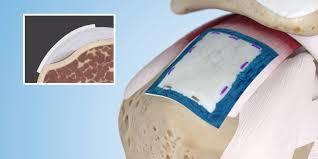
This rehabilitation protocol is designed for patients recovering from xenograft-augmented partial thickness rotator cuff repair procedures. The goal of rehabilitation is to safely protect the biologic repair while restoring mobility, strength, neuromuscular control, and long-term shoulder performance. Xenografts and other “patch augments” offer an option for a faster recovery for symptomatic partial thickness rotator cuff tears that allows for protection of the native rotator cuff tissue a biologic solution to strengthen the rotator cuff long term.
How Does It Work?
When a patch or xenograft is placed onto a partially torn rotator cuff, it allows for the patient’s own rotator cuff to heal by decreasing the strain on the tissue. When the patch is placed, it allows the body to heal itself naturally and over time, grow new tissue (collagen) to both strengthen the rotator cuff and potentially decrease the risk of a full tear in the future.
General Rehabilitation Principles
- Protect biologic tendon healing during the early postoperative period
- Gradually restore shoulder mobility without overstressing healing tissue
- Optimize scapular mechanics and rotator cuff activation
- Restore dynamic shoulder stability and endurance
- Progressively return to lifting, overhead activity, and sport
Rehabilitation Timeline Overview
| Phase | Timeline | Primary Goals |
|---|---|---|
| Phase I | Weeks 0-1 | Protection, pain control, passive mobility |
| Phase II | Weeks 1-6 | Restore mobility and early strengthening |
| Phase III | Weeks 6-12+ | Advanced strengthening and return to activity |
PHASE I — PROTECTION & EARLY MOBILITY (Weeks 0-1)
Interventions
- Use sling for comfort and protection during the first 48-72 hours (please wait for the nerve block to wear off)
- Initiate pendulum exercises and protected passive ROM
- No lifting greater than 5 pounds
- Avoid sudden shoulder movements and excessive stretching
- Begin scapular activation and postural drills
PHASE II — RESTORE MOTION & EARLY STRENGTH (Weeks 1-6)
Interventions
- Wean from sling as tolerated
- Progress passive, active-assisted, and active ROM
- Initiate rotator cuff and scapular isometrics
- Begin Theraband internal/external rotation
- Emphasize movement quality and neuromuscular control
PHASE III — ADVANCED STRENGTH & RETURN TO PERFORMANCE (Weeks 6-12+)
Interventions
- Progress dumbbell and resistance training
- Advance rotator cuff endurance and scapular stability
- Introduce plyometrics and sport-specific drills
- Progress interval throwing or overhead programs if indicated
- Continue long-term maintenance strengthening
Movement Quality & Strength Progression
Rehabilitation should prioritize movement quality, tendon tolerance, and scapular control over aggressive loading. Progress strengthening gradually and avoid painful exercise progression.
Return to Sport Considerations
Return to sport should be individualized based on strength recovery, movement quality, endurance, and sport-specific demands. Many patients continue improving shoulder function for several months following surgery.
Final Notes for Patients
Recovery after xenograft rotator cuff repair requires patience, consistency, and gradual progression. Long-term success depends on protecting the repair, restoring shoulder mechanics, maintaining strength and endurance, and progressing activity carefully over time.